Faster rails can shorten the journey
Liquidity at both ends determines whether the payment arrives
Julien Olivier, Head of MENA Trading
In 2020, while trading at a bank in London, I sold a treasury bill in a frontier market. The trade and custody worked. Repatriating the dollars took two days on a good day and weeks on a bad one. The problem was dollar liquidity at the other end.
I have since seen the same pattern across banking, cross-border payments and digital assets. Price and speed matter, but my first question is who has the right currency, in the right place, when a payout is due.
That is why I see payments as a balance-sheet problem. Faster rails can shorten the funding window. They cannot create local liquidity or decide who carries the risk.
The liquidity behind every payment
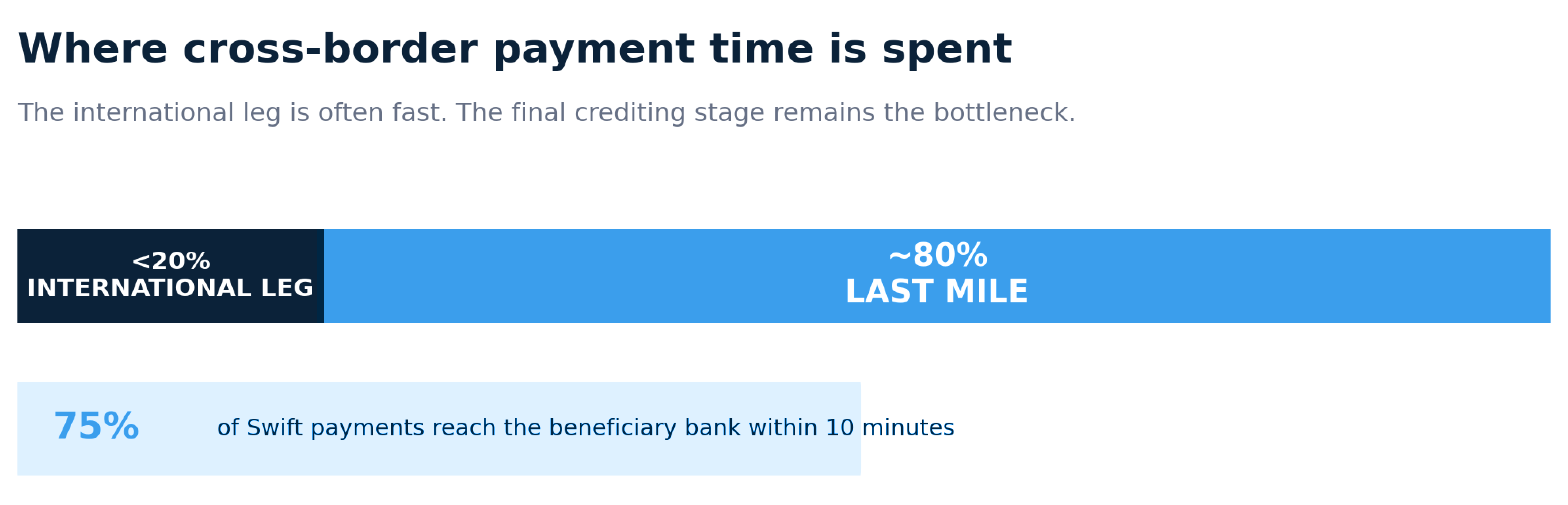
I judge a corridor by what happens when conditions deteriorate. A fast international leg means little if the beneficiary cannot access the funds.
Swift reported in July 2026 that 75% of payments on its network reached beneficiary banks within 10 minutes, yet around 80% of total processing time was spent in the last mile before crediting.
Source: Swift, July 2026
That final step depends on money already being available locally. Consider a UAE importer paying a supplier in an emerging market. The importer sends dirhams; the supplier expects local currency. The provider bridges that gap using capital already held locally. Hedging may require margin elsewhere.
I reduce this to money multiplied by time. Netting can reduce the amount that must move; faster settlement can shorten the wait. As the BIS notes, netting still leaves obligations to settle and counterparty credit risk.
This waiting period is also where settlement, credit and FX meet. We often manage them separately, but I see one exposure: someone has delivered value while someone else is waiting.
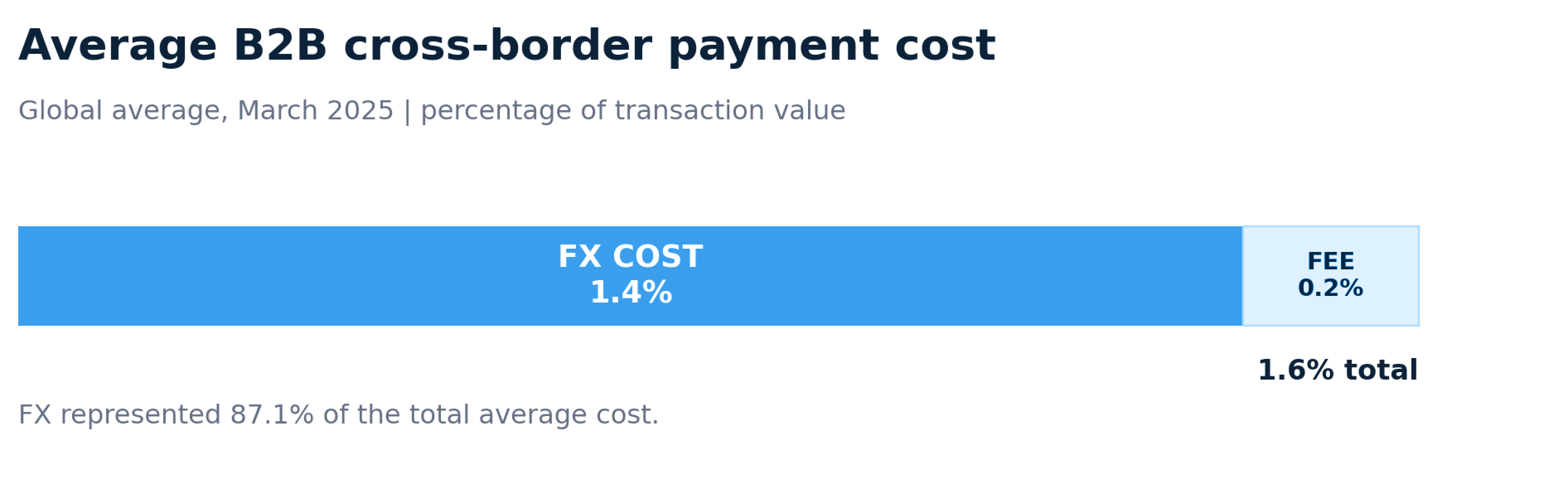
The transfer fee therefore tells only part of the story. In the FSB’s 2025 data, average B2B cross-border payment costs were 1.6% of transaction value. FX represented 87.1% of that cost, showing why liquidity and conversion deserve attention alongside fees.
Source: Financial Stability Board, 2025
Making faster rails work
This is where I see stablecoins adding practical value. They can shorten funding windows, move digital value outside banking hours and improve transaction visibility, allowing the same capital to turn more quickly.
But a faster transfer does not guarantee a completed payout. The economics still depend on the route. The BIS finds uneven cross-border performance once spreads and on- and off-ramp costs are included.
Stablecoins do not create local currency, keep banks open on public holidays or remove compliance checks. A transfer can settle on-chain while the payout waits for liquidity, banking access or operational capacity.
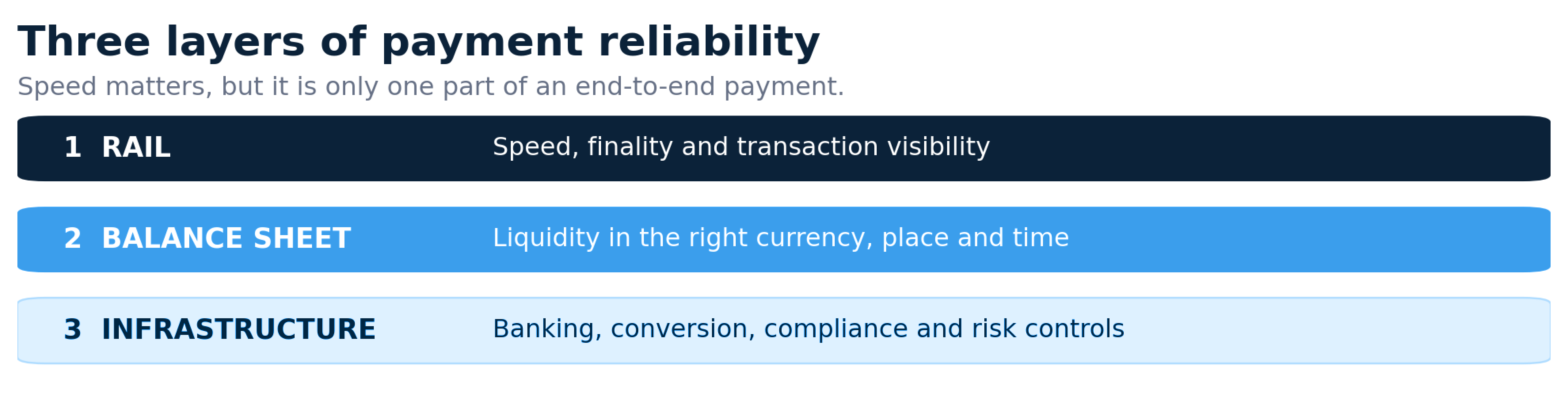
For me, reliability requires a fast rail, liquidity at both ends and infrastructure connecting banking, conversion, risk and compliance.
Putting those pieces together requires banking access, trusted counterparties and local liquidity in each corridor. The BIS identifies limited interoperability and differences between national systems as constraints on cross-border payments.
At Aquanow, we bring together institutional liquidity, compliant operations and technology for digital-asset and stablecoin services. This helps institutions connect workflows without rebuilding every underlying connection.
I see the role of an infrastructure partner as improving reach and reliability through specialist liquidity and execution capabilities. Institutions still retain responsibility for their customer relationships and applicable compliance obligations.
When I assess a corridor, I want to know what happens when a bank closes or a payout partner runs short of liquidity, how much capital must remain parked and who carries settlement, credit and FX exposure until payout. I also ask whether the same infrastructure can support the next corridor.
The rail determines speed. The balance sheet determines availability. The infrastructure connecting them determines reliability.